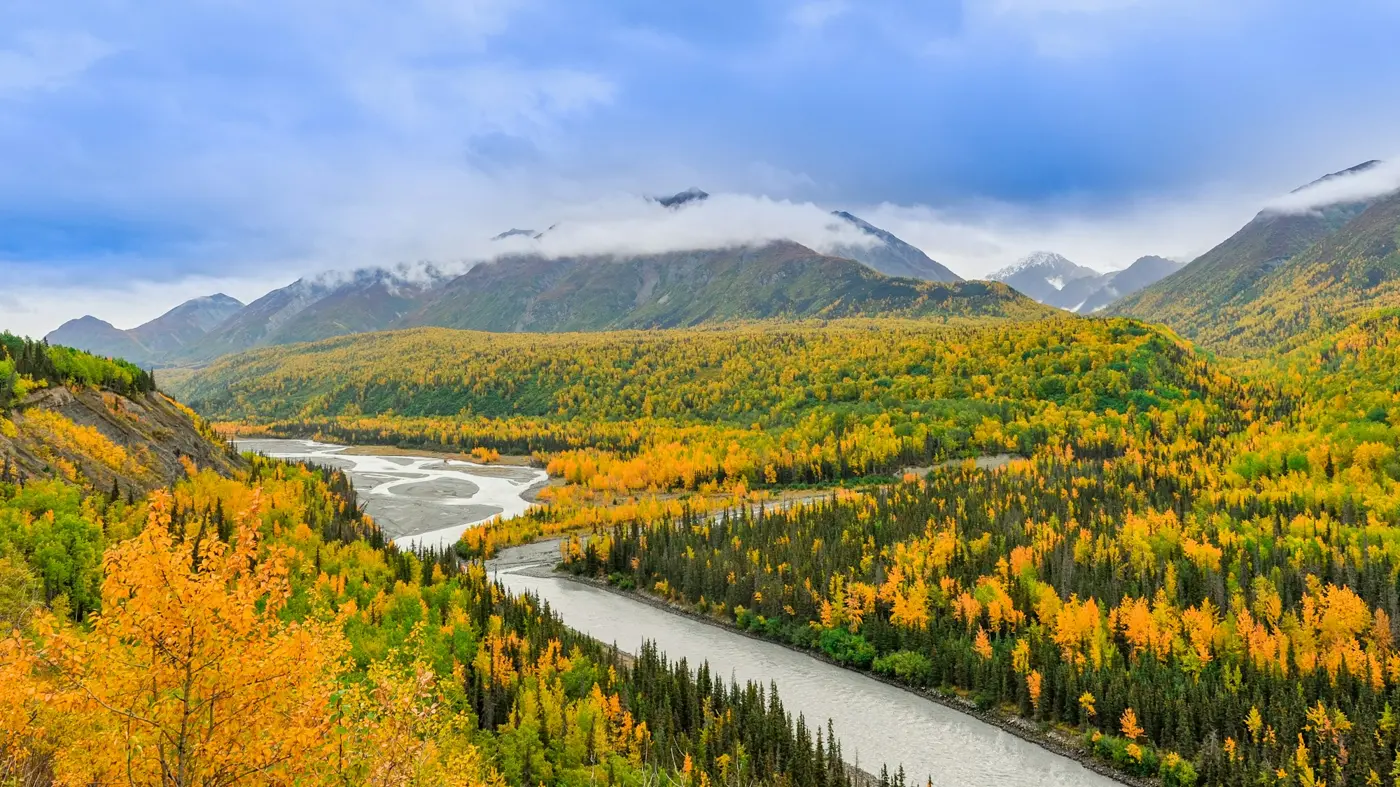
Studying in Alaska 2026 — Tuition, Cost & Universities
The Last Frontier — Arctic research, raw wilderness, and the University of Alaska
- Flagship
- UA Fairbanks
- Out-of-state tuition
- ~$28–32k/yr
- Cost of living
- High
- Top industry
- Oil & gas
- Rent
- $950
- Food
- $310
- Transport
- $170
- Personal
- $270
Studying in Alaska as an international student
Alaska is the most remote and most dramatic place to study in the United States. Its flagship, the University of Alaska Fairbanks (UAF), is a world leader in Arctic science, geophysics, and the study of the aurora and climate — research you genuinely cannot do anywhere else. The University of Alaska system is also far cheaper than the famous coastal schools.
As an international student you pay nonresident tuition — roughly US$28,000–32,000/year at the University of Alaska. The catch is the cost of living: because nearly everything ships or flies in, daily life in Fairbanks or Anchorage runs US$18,000–22,000/year. This guide gives you the real 2026 numbers, and an honest word about the long, dark winters.
Tuition: in-state vs out-of-state vs international
Alaska's higher education is built around the public University of Alaska system. There are no large private universities, so the in-state vs nonresident split is the whole story. International students pay the nonresident (out-of-state) rate — the in-state column below is shown only for context (F-1 students cannot normally qualify for it).
| Institution type | In-state (context) | International / nonresident | Notes |
|---|---|---|---|
| UAF (research flagship, Fairbanks) | ~US$9,000/yr | ~US$30,000/yr | Arctic & geophysics research |
| UAA (Anchorage) | ~US$9,000/yr | ~US$30,000/yr | Health, business, engineering |
| UA Southeast (Juneau) | ~US$8,500/yr | ~US$28,000/yr | Smaller; marine & liberal arts |
| Community campuses | ~US$5,500/yr | ~US$14,000–18,000/yr | Lower per-credit; transfer route |
The community-college route is the cheapest way through: UAA and UAF run two-year and community campuses with lower per-credit costs. Start there, then transfer into a bachelor's programme for the final years and earn the same degree for less.
Nonresident note: an F-1 visa is a temporary, non-immigrant status, so you generally cannot establish Alaska residency for tuition purposes. Plan on the nonresident rate across your whole degree — there is no elite-private tier to compare against here.
Top universities in Alaska
| University | Type | City | Approx. intl tuition/yr |
|---|---|---|---|
| University of Alaska Fairbanks (UAF) | Public | Fairbanks | ~US$30,000 |
| University of Alaska Anchorage (UAA) | Public | Anchorage | ~US$30,000 |
| University of Alaska Southeast | Public | Juneau | ~US$28,000 |
UAF is the research flagship and a world leader in Arctic science, geophysics, atmospheric and aurora research, and climate science — it runs the Geophysical Institute and sits under prime aurora skies, so its location is a genuine scientific advantage rather than a backdrop. UAA, in the state's largest city, is stronger for health sciences, business, and engineering, with closer access to internships and the Anchorage corporate base. UA Southeast in Juneau is the smallest of the three, with strengths in marine biology, fisheries, and the liberal arts. For geophysics, environmental science, and field research, the University of Alaska punches far above its size.
Cost of living by city
Alaska is expensive because of its remoteness — almost every product is shipped or flown in, and heating is a real winter line item. Monthly all-in estimates for a student:
| City | Shared room rent | Total monthly (all-in) |
|---|---|---|
| Fairbanks | US$800–1,100 | US$1,500–1,900 |
| Anchorage | US$900–1,300 | US$1,600–2,000 |
| Juneau | US$1,000–1,400 | US$1,700–2,100 |
Housing tip: secure university housing the moment you are admitted — on-campus rooms include heat, which is a meaningful saving when winter utility bills can run US$200–400/month off-campus. Remote campuses and smaller towns can be even pricier for groceries, since everything arrives by barge or plane. Budget more than you would for a mid-sized mainland US city. Use our cost-of-study calculator to model your own budget.
Health insurance, climate & safety
Health insurance is mandatory. The University of Alaska requires international students to carry coverage and offers a student plan — typically in the US$2,500–5,000/year range — unless you waive it with comparable insurance. US healthcare is expensive, and rural Alaska medical care can mean costly air transport to a larger hospital, so never go uninsured.
Climate, honestly: Alaska winters are long, cold, and very dark — in Fairbanks the sun barely rises in December, and a few hours of twilight is all you get. Summers, by contrast, bring near-endless daylight and some of the most spectacular wilderness on Earth. The dark season is real; many students use vitamin-D supplements and daylight lamps. Go in clear-eyed: if extreme nature and short winter days suit you, nowhere is better.
Safety: campus areas in Fairbanks, Anchorage, and Juneau are safe and community-minded. The genuine risks in Alaska are environmental — extreme cold, wildlife, and remote travel — rather than crime. Learn cold-weather basics early, dress for the temperature, and you will be fine.
Jobs & careers after graduation
Work authorization itself — on-campus work, CPT, and post-graduation OPT / STEM OPT — is governed by US federal immigration rules, not by Alaska. See our USA work & career guide and visa & arrival guide for the mechanics.
Alaska's economy is small but distinctive, with strong demand in a handful of sectors:
- Oil & gas — the North Slope and Anchorage corporate base.
- Commercial fishing & seafood — one of the world's biggest fisheries.
- Tourism — cruise, wilderness, and adventure travel.
- Arctic & climate research — UAF spins off research and government science roles.
For geophysics, environmental science, and engineering graduates, Alaska offers research and field roles that are genuinely rare elsewhere.
Frequently asked questions
How much does it cost an international student to study in Alaska?
Budget roughly US$45,000–55,000/year all-in — about US$30,000 in nonresident tuition plus US$18,000–22,000 for living in a remote, ship-everything-in state.
Do international students pay in-state or out-of-state tuition?
Out-of-state (nonresident). F-1 students cannot normally establish Alaska residency for tuition, so plan on the nonresident rate for your whole degree.
What is UAF known for?
The University of Alaska Fairbanks is a global leader in Arctic science, geophysics, atmospheric and aurora research, and climate science — fields where its location is a genuine advantage.
Can international students work in Alaska?
Work rules (CPT/OPT) are federal — see the USA guides. Alaska's job strengths are oil and gas, fishing, tourism, and Arctic research.
Compare Alaska with the rest of the USA
Explore the full USA study guide for visas, admissions, and costs — then model your own budget with the cost-of-study calculator.
Open the USA study guide