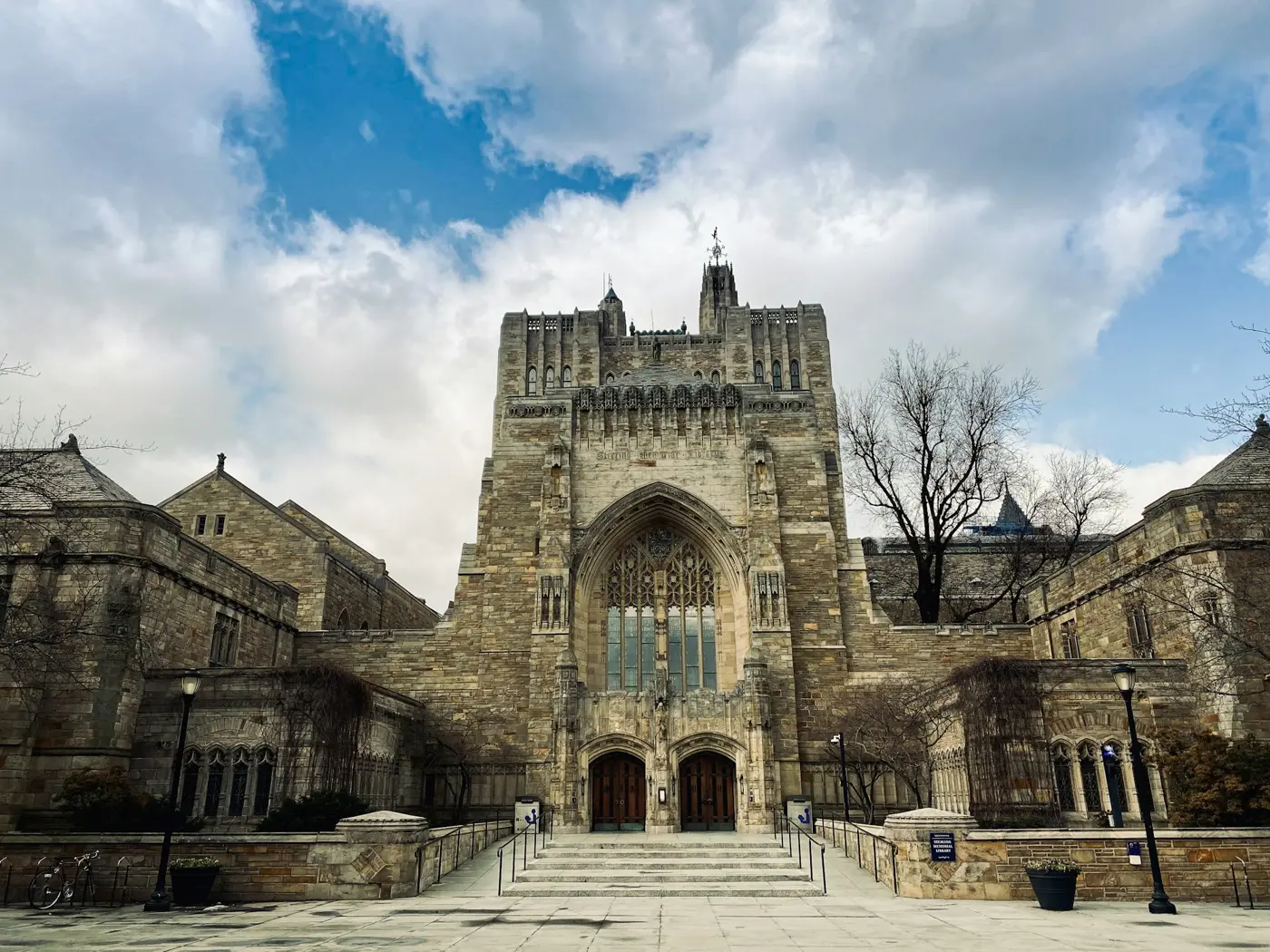
Studying in Connecticut 2026 — Tuition, Cost & Universities
New England's wealth corridor — Yale, the insurance capital, and easy reach of NYC and Boston
- Flagship
- UConn / Yale
- Out-of-state tuition
- ~$43k (UConn)
- Cost of living
- $1,400–2,000/mo
- Top industry
- Insurance & finance
- Rent
- $950
- Food
- $315
- Transport
- $175
- Personal
- $310
Studying in Connecticut as an international student
Connecticut packs world-class education into a small, wealthy New England state. Yale University in New Haven is an Ivy League global top-20, while the public flagship University of Connecticut (UConn) charges international students about US$43,000/year in nonresident tuition. Cost of living is on the higher side — US$1,400–2,000/month in New Haven or Hartford — but well below neighbouring New York City. The state's signature industry is insurance and finance, centred on Hartford, the "insurance capital of the world".
The big draw is location. New Haven sits on the main rail line, putting you under two hours from both New York City and Boston, with their internships and weekend trips, while you pay a fraction of Manhattan rents. Add a dense cluster of defense, pharma, and healthcare employers, and Connecticut becomes one of the most quietly practical states for an international degree. This guide lays out the real 2026 numbers — tuition, living costs, insurance, and the job market — so you can plan with open eyes.
Tuition: in-state vs out-of-state vs international
Connecticut has a public flagship (UConn), four regional Connecticut State Universities, a statewide community college, and a tier of elite privates. International students pay the nonresident (out-of-state) rate — the in-state column below is shown only for context (F-1 students cannot normally qualify for it).
| Institution type | In-state (context) | International / nonresident | Notes |
|---|---|---|---|
| UConn (public flagship) | ~US$20,000/yr | ~US$43,000/yr | Top public research university in the state |
| CT State Universities (Central, Southern, Eastern, Western) | ~US$12,000/yr | ~US$24,000–27,000/yr | Practical, more affordable public option |
| CT State Community College | ~US$4,500/yr | ~US$12,000–15,000/yr | Transfer route into UConn / CSU |
| Private (Yale, Wesleyan, Trinity) | — | ~US$65,000–67,000/yr | Yale offers need-based aid to some internationals |
The community-college transfer route is Connecticut's biggest cost saver: start at the statewide Connecticut State Community College (~US$13,000/year for internationals), then transfer into UConn or a CSU campus for your final two years and the same bachelor's degree. Articulation agreements smooth the credit transfer. International students pay the nonresident rate at every public institution — F-1 status is temporary, so plan on it for the full degree.
Top universities in Connecticut
| University | Type | City | Approx. intl tuition/yr |
|---|---|---|---|
| Yale University | Private (Ivy League) | New Haven | ~US$67,000 |
| University of Connecticut (UConn) | Public flagship | Storrs | ~US$43,000 |
| Wesleyan University | Private (liberal arts) | Middletown | ~US$66,000 |
| Trinity College | Private (liberal arts) | Hartford | ~US$65,000 |
| Fairfield University | Private (Jesuit) | Fairfield | ~US$56,000 |
| Quinnipiac University | Private | Hamden | ~US$52,000 |
Yale is a global top-20 institution, exceptional in law, medicine, drama, music, and the humanities, with one of the world's largest university endowments behind its research. UConn anchors the public system with strong engineering, business, nursing, and pharmacy programs and a nationally known athletics culture. Wesleyan, Trinity, and Connecticut College deliver small-class liberal-arts teaching, while Fairfield and Quinnipiac are popular for business, communications, and the health professions.
Cost of living by city
Connecticut is a wealthier, pricier state, but cheaper than NYC next door. Costs swing sharply between college towns and the Fairfield County commuter belt. Monthly all-in estimates for a student:
| City / area | Shared room rent | Total monthly (all-in) |
|---|---|---|
| Stamford / Fairfield County | US$1,000–1,500 | US$1,900–2,500 |
| New Haven (Yale) | US$800–1,100 | US$1,500–2,000 |
| Hartford | US$700–1,000 | US$1,400–1,900 |
| Storrs (UConn) | US$600–900 | US$1,200–1,600 |
Housing tip: Storrs and Hartford are the budget-friendly options; Fairfield County, in NYC's orbit, is the priciest. Apply for university housing the moment you are admitted, and look at New Haven's well-connected neighbourhoods or a shared apartment near campus to keep rent down. Use our cost-of-study calculator to model your own numbers.
Health insurance, climate & safety
Health insurance is mandatory. Connecticut campuses auto-enrol you in their Student Health Insurance Plan (SHIP, ~US$2,500–5,000/year) unless you waive it with comparable coverage. Never go uninsured in the US — a single hospital visit or emergency can cost many thousands of dollars.
Climate, honestly: four real seasons. Winters are cold and snowy (often below freezing December–February), summers are warm and humid, and autumn brings the classic New England foliage. Pack a proper winter coat and waterproof boots.
Safety varies by neighbourhood far more than by state. College towns like Storrs and the campus areas around Yale are well-patrolled and safe; like any city, downtown Hartford and parts of New Haven have areas to learn and avoid at night. Choose your neighbourhood with the same care you would in any mid-sized US city, and you will be fine.
Jobs & careers after graduation
Work authorization itself — on-campus work, CPT, and post-graduation OPT / STEM OPT — is governed by US federal immigration rules, not by Connecticut. See our USA work & career guide and visa & arrival guide for the mechanics.
What Connecticut adds is a concentrated, high-value job market:
- Insurance & finance — Hartford is the US insurance capital (The Hartford, Aetna, Travelers, Cigna), a global hub for actuarial and underwriting careers.
- Defense & aerospace — Electric Boat (submarines), Pratt & Whitney (jet engines), and Sikorsky (helicopters).
- Pharma & life sciences — a growing biotech cluster, plus major employers along the New Haven–Boston corridor.
- Healthcare — large hospital systems and the Yale medical complex.
- Finance overflow from NYC — hedge funds and asset managers concentrated in Fairfield County.
For finance, actuarial science, and engineering graduates on OPT, Connecticut offers a dense cluster of relevant employers within commuting distance — and New York and Boston are both a short train ride away.
Frequently asked questions
How much does it cost an international student to study in Connecticut?
At UConn, budget US$60,000–65,000/year all-in (~US$43k tuition + ~US$18k living). Yale costs more (~US$67k tuition, US$90k+ all-in) but offers need-based aid to some internationals. Community colleges (~US$12k–15k/year) are the cheapest entry point.
Do international students pay in-state or out-of-state tuition?
Out-of-state (nonresident). At UConn that is ~US$43,000 versus ~US$20,000 for residents. F-1 students cannot normally establish Connecticut residency for tuition.
What are the best universities in Connecticut?
Yale (Ivy League, global top-20), UConn (public research flagship), plus the respected liberal-arts colleges Wesleyan, Trinity, and Connecticut College, and professional-focused Fairfield and Quinnipiac.
Is health insurance mandatory?
Yes. Campuses auto-enrol you in a SHIP plan (~US$2,500–5,000/year) unless you waive it with comparable coverage.
Can international students work in Connecticut?
Work rules (CPT/OPT) are federal — see the USA guides. Connecticut's advantage is its job market: insurance and finance in Hartford, defense at Electric Boat and Pratt & Whitney, and healthcare, with NYC and Boston both an easy train ride away.
Compare Connecticut with the rest of the USA
Explore the full USA study guide for visas, admissions, and costs — then model your own budget with the cost-of-study calculator.
Open the USA study guide