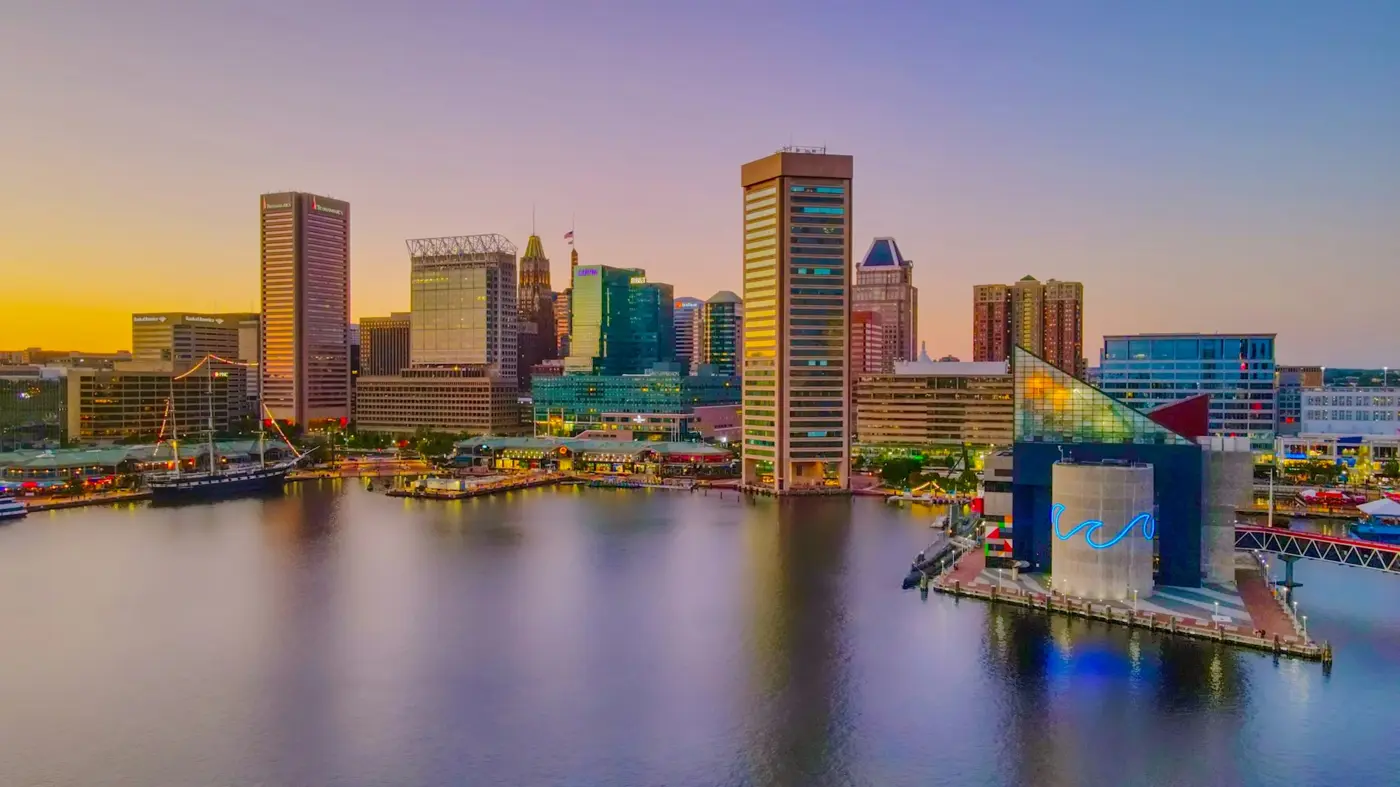
Studying in Maryland 2026 — Tuition, Cost & Universities
The Old Line State — top research universities next to Washington, DC, and a biotech and cybersecurity powerhouse
- Flagship
- UMD College Park
- Out-of-state tuition
- ~$40–65k/yr
- Cost of living
- $1,800–2,400/mo
- Top industry
- Biotech
- Rent
- $1,155
- Food
- $378
- Transport
- $210
- Personal
- $357
Studying in Maryland as an international student
Maryland packs two heavyweight research universities into a small state right beside Washington, DC. The public flagship, the University of Maryland, College Park, is strong in computer science and engineering and sits just outside the capital. In Baltimore, Johns Hopkins University is among the world's leading private research universities — number one in the US for research spending and a global leader in medicine and public health. For many internationals, the real draw is what surrounds these campuses: the NIH, the NSA, and a dense federal job market within commuting distance.
As an international student you pay nonresident (out-of-state) tuition at the University of Maryland — roughly US$40,000/year — plus about US$18,000–26,000/year for living in the pricey DC metro, putting a year around US$58,000–66,000 all-in. Johns Hopkins, as a private university, charges about US$65,000 in tuition regardless of residency, and community-college transfer is a far cheaper route to the same public degree. This guide breaks down the real 2026 numbers so you can plan with open eyes.
Tuition: in-state vs out-of-state vs international
Maryland has strong public universities plus elite privates. At public universities, international students pay the nonresident (out-of-state) rate — the in-state column below is shown only for context (F-1 students cannot normally qualify for it). Private universities like Johns Hopkins charge the same tuition regardless of residency.
| Institution type | In-state (context) | International / nonresident | Notes |
|---|---|---|---|
| UMD College Park (flagship) | ~US$11,500/yr | ~US$40,000/yr | Top CS and engineering; next to DC |
| UMBC (public) | ~US$12,000/yr | ~US$30,000/yr | Strong in CS, data science, sciences |
| Maryland community colleges | ~US$5,500/yr | ~US$9,000–13,000/yr | Cheapest entry; transfer route into UMD |
| Johns Hopkins (private) | — | ~US$65,000/yr | Same rate for all; world-leading research |
The community-college transfer route is the cheapest path in: Maryland community colleges charge international students roughly US$9,000–13,000/year; complete two years and transfer into the University of Maryland or another public university for the final two and the same bachelor's degree — often cutting the total cost by 30–40%.
At public schools, an F-1 visa is a temporary, non-immigrant status, so establishing Maryland residency for tuition is generally not possible. Plan on the nonresident rate for your whole degree. Private universities such as Johns Hopkins charge one flat tuition regardless of where you are from.
Top universities in Maryland
| University | Type | City | Approx. intl tuition/yr |
|---|---|---|---|
| University of Maryland, College Park | Public | College Park | ~US$40,000 |
| Johns Hopkins University | Private | Baltimore | ~US$65,000 |
| University of Maryland, Baltimore County (UMBC) | Public | Baltimore | ~US$30,000 |
| Towson University | Public | Towson | ~US$26,000 |
| Maryland community colleges | Community college | Statewide | ~US$9,000–13,000 |
The University of Maryland, College Park is the public flagship — a top-tier research university especially strong in computer science, engineering, and the physical sciences, sitting on the DC Metro line just outside the capital. Johns Hopkins University in Baltimore is among the world's leading private research universities, ranked number one in the US for research spending and a global leader in medicine, public health, and biomedical engineering. UMBC has built a national reputation in computer science and data science, while Maryland's community colleges offer affordable transfer pathways. Proximity to the NIH, NSA, and DC means internships and research placements are unusually close.
Cost of living by city
Maryland runs higher than most states because much of it lies in the expensive Washington, DC metro. Monthly all-in estimates for a student:
| City / area | Shared room rent | Total monthly (all-in) |
|---|---|---|
| College Park / DC metro | US$1,000–1,500 | US$1,800–2,400 |
| Baltimore | US$800–1,200 | US$1,500–2,000 |
| Smaller towns (e.g. Frederick) | US$750–1,100 | US$1,400–1,900 |
Housing is the make-or-break cost. Baltimore and smaller towns like Frederick are noticeably cheaper than College Park and the DC metro, where demand keeps rents high. Apply for university housing the moment you are admitted, and use the region's strong transit network to live a little further out for less. Use our cost-of-study calculator to model your own numbers.
Health insurance, climate & safety
Health insurance is mandatory. Maryland universities auto-enroll international students in a campus Student Health Insurance Plan (SHIP, roughly US$3,000–5,000/year) unless you waive it with comparable coverage. Never go uninsured in the US — a single hospital visit can cost thousands.
Climate is four full seasons: hot, humid summers; cold winters with periodic snow; and pleasant spring and autumn. Maryland touches the Atlantic, so the occasional tropical storm or hurricane remnant can pass through in late summer, but inland campuses like College Park rarely see serious disruption — it is a mild, manageable part of life here.
Safety varies by neighborhood far more than by state. College Park is a busy campus town on the DC transit network and the suburbs are generally safe; in Baltimore, neighborhoods differ sharply, so choose yours with the same care you would in any major US city and follow university guidance.
Jobs & careers after graduation
Work authorization itself — on-campus work, CPT, and post-graduation OPT / STEM OPT — is governed by US federal immigration rules, not by Maryland. See our USA work & career guide and visa & arrival guide for the mechanics.
What Maryland adds is one of the densest professional job markets in the country:
- Biotech & health — anchored by the National Institutes of Health (NIH) and Johns Hopkins, with a large life-sciences corridor along I-270.
- Cybersecurity & defense — the National Security Agency (NSA) and a cluster of defense contractors make Maryland a national hub for security careers.
- Federal & government-adjacent — proximity to Washington, DC opens an enormous pool of agency, contractor, and policy employers.
- Tech & data science — a growing software and analytics sector across the DC–Baltimore corridor.
For STEM, health, and security graduates on the 3-year STEM OPT extension, few states put more relevant employers within commuting distance.
Frequently asked questions
How much does it cost an international student to study in Maryland?
Budget roughly US$58,000–66,000/year all-in at the University of Maryland (≈US$40k tuition + ≈US$22k living in the DC metro). Private Johns Hopkins runs around US$65,000 tuition. Community colleges (~US$9,000–13,000/year) are the cheapest path.
Do international students pay in-state or out-of-state tuition?
Out-of-state (nonresident) at public universities like the University of Maryland. F-1 students cannot normally establish residency for tuition. Private universities such as Johns Hopkins charge the same tuition regardless of residency.
Why is Maryland more expensive than other Southern states?
Much of Maryland sits in the Washington, DC metro, one of the pricier US housing markets. Baltimore and smaller towns are noticeably cheaper than College Park.
Is it cheaper to start at a community college?
Yes — substantially. Maryland community colleges charge international students roughly US$9,000–13,000/year versus ~US$40,000 at UMD, with transfer pathways into the public universities. This can cut a bachelor's total cost by 30–40%.
Can international students work in Maryland?
Work rules (CPT/OPT) are federal — see the USA guides. Maryland's advantage is its job market: biotech and health (NIH, Johns Hopkins), cybersecurity and defense (NSA), and federal and government-adjacent employers.
Compare Maryland with the rest of the USA
Explore the full USA study guide for visas, admissions, and costs — then model your own budget with the cost-of-study calculator.
Open the USA study guide