Why Study en Rusia - Estudiar en Rusia (es)
Russia offers affordable tuition, a fully funded government scholarship, world-class STEM and medicine programs, and a rich cultural experience -- here's why over 350,000 estudiantes internacionales choose it.
Why Study en Rusia
Russia has quietly become one of the world's top destinations for estudiantes internacionales, now hosting over 350,000 students from mas de 170 countries. It is not the first country most students think of, but those who look closely discover a combination that is genuinely hard to match: highly affordable tuition at serious universities, a fully funded government scholarship program, world-class programs in STEM and medicine, the chance to learn one of the world's most strategically important languages, and a cultural experience unlike anything you will find in Western Europe, North America, or Australia. Here is why Russia deserves a place on your shortlist.
Genuinely Affordable Tuition
The single most compelling reason to study en Rusia is cost. Tuition at Russian public universities is dramatically lower than virtually any other major study destination:
| Cost comparison | Russia | UK | US (public, out-of-state) | Australia |
|---|---|---|---|---|
| Annual tuition | RUB 120,000-400,000 (USD 1,200-4,000) | GBP 20,000-40,000 | USD 25,000-45,000 | AUD 25,000-45,000 |
| 2-year Master's total tuition | USD 2,400-8,000 | GBP 40,000-80,000 | USD 50,000-90,000 | AUD 50,000-90,000 |
| 4-year Specialist total tuition | USD 4,800-16,000 | N/A | USD 100,000-180,000 | AUD 100,000-180,000 |
These are not second-tier institutions. Moscow State University, ranked in the global top 100, charges estudiantes internacionales aproximadamente RUB 350,000-400,000/year (about USD 3,500-4,000) for most programs. St. Petersburg State, MIPT, and ITMO -- all globally ranked -- charge similar amounts. Regional universities like Kazan Federal, Tomsk State, and Novosibirsk State charge even less, often RUB 120,000-200,000/year.
When you add en Rusia's very low costes de vida -- RUB 15,000-30,000/month (USD 150-300) covers dormitory rent, food, and transport in most cities -- the total cost of a Russian degree is a fraction of what you would pay almost anywhere else.
Consejo: Even without the government scholarship, the total cost of a 2-year Master's en Rusia (tuition + living) can be menos de a single year of tuition at many US, UK, or Australian universities. Factor in the scholarship, and the equation becomes even more compelling.
The Russian Government Scholarship -- A Genuine Full Ride
de Rusia most powerful draw for estudiantes internacionales is the Russian Government Scholarship, also known as the Quota program. This is not a partial tuition discount -- it is a comprehensive fully funded scholarship:
- Tuition -- fully covered at any participating public university
- Dormitory housing -- free or heavily subsidized
- Monthly stipend -- RUB 1,700-3,000/month for gastos de vida (modest, but ademas de free housing)
- No separate tasa de solicitud -- apply through the Study en Rusia portal (education-in-russia.com) or your country's Russian embassy
The scholarship covers Bachelor's, Specialist, Master's, and PhD programs. Thousands of places are allocated each year across over 170 countries, with quotas varying by country. The selection process normalmente involves an interview and academic evaluation. While competitive, the acceptance rates are significativamente higher than comparable scholarships in the US or UK, making this a realistic opportunity for strong students.
| Scholarship detail | Information |
|---|---|
| Coverage | Full tuition + dormitory + monthly stipend |
| Duration | Full length of program (4-6 years for Bachelor's/Specialist, 2 years for Master's, 3-4 years for PhD) |
| Number of places | Aproximadamente 15,000-18,000 al ano across all countries |
| Application | Study en Rusia portal or Russian embassy in your country |
| Deadline | Varies by country -- normalmente February to April |
| Requirements | Expedientes academicos, passport, medical certificate, application form |
Consejo: Solicita pronto through the Study en Rusia portal (education-in-russia.com). Selection starts in January-February for the following September intake. Research which universities participate in the quota program and list your preferences carefully -- the portal allows you to select hasta six universities.
World-Class STEM and Medicine Programs
de Rusia greatest academic strength lies in STEM -- science, technology, engineering, and mathematics. This is not marketing; it is decades of measurable results:
Mathematics and Physics
Russia has one of the world's strongest mathematical traditions. Russian and Soviet mathematicians have won 9 Fields Medals (the Nobel Prize equivalent for mathematics), including Grigori Perelman who proved the Poincare conjecture. Universities like Moscow State, MIPT, and St. Petersburg State have mathematics and physics programs that compete with MIT, Cambridge, and ETH Zurich.
Engineering
de Rusia engineering programs are rooted in the Soviet era's massive investment in aerospace, nuclear energy, and defence technology:
- Aerospace -- Russia remains one of only a few countries with a complete space program. Bauman Moscow State Technical University and the Moscow Aviation Institute (MAI) are leaders.
- Nuclear engineering -- Russia operates one of the world's largest nuclear power programs. MEPhI (National Research Nuclear University) is the premier institution.
- Mechanical and civil engineering -- strong programs at Bauman, SPbPU (Peter the Great Polytechnic), and MISIS.
Computer Science and IT
Russia has become a powerhouse in competitive programming and IT education. ITMO University students have won the ACM International Collegiate Programming Contest (ICPC) more times than any other university in the world. HSE University, MIPT, and Innopolis University (de Rusia dedicated IT university) offer cutting-edge programs in computer science, data science, and artificial intelligence.
Medicine
Russia has a long tradition in medical education, and Russian medical degrees are recognized by the WHO and listed in the World Directory of Medical Schools. Programs are normalmente 6 years (General Medicine Specialist degree) and estan disponibles in both Russian and English at major medical universities. Tuition for impartido en ingles medical programs ranges from RUB 200,000-500,000/year -- still dramatically cheaper than US, UK, or Australian medical schools.
| Field | Top universities | Global recognition |
|---|---|---|
| Mathematics | Moscow State, MIPT, St. Petersburg State, HSE | 9 Fields Medals; top global rankings |
| Physics | MIPT, Moscow State, Novosibirsk State, MEPhI | Multiple Nobel Prizes; CERN partnerships |
| Engineering | Bauman MSTU, SPbPU, MISIS, MAI | Leading aerospace and nuclear programs |
| Computer Science | ITMO, MIPT, HSE, Innopolis | Most ICPC world championships |
| Medicine | Sechenov, Pirogov RNIMU, Kazan SMU, PSPbSMU | WHO recognized; 6-year Specialist degree |
Learn Russian -- A Strategic Global Language
Studying en Rusia gives you access to one of the world's most strategically important languages. Russian is:
- Spoken by 250+ million people worldwide
- An official UN language and one of the six working languages of international diplomacy
- The lingua franca of Central Asia and the Caucasus -- essential for business and diplomacy across Kazakhstan, Uzbekistan, Kyrgyzstan, Tajikistan, and beyond
- A major language of science and technology -- vast amounts of scientific literature, especialmente in physics, mathematics, and engineering, are published en Rusian
- Increasingly valued by employers -- multinational companies, diplomatic services, NGOs, and security agencies actively seek Russian speakers
Even if you enrol in an impartido en ingles program, living en Rusia for 2-4 years will give you substantial idioma ruso exposure. Most universities offer idioma ruso courses as part of the curriculum or through supplementary programs. Students who arrive for the preparatory faculty year normalmente reach B1-B2 level en Rusian within 10-12 months.
Consejo: idioma ruso proficiency significativamente expands your career options after graduation -- in diplomacy, international business, energy, translation, and academia. Even intermediate Russian (B1-B2) sets you apart from most international graduates.
Rich Cultural Heritage
de Rusia cultural legacy is genuinely unmatched in its scale and depth:
- Literature -- the country of Tolstoy, Dostoevsky, Chekhov, Pushkin, and Bulgakov. Russian literature is studied worldwide and experiencing it in the original language is a privilege few students from other countries get.
- Music -- Tchaikovsky, Rachmaninoff, Shostakovich, Prokofiev. The Moscow Conservatory and St. Petersburg Conservatory are among the world's most prestigious music schools.
- Theatre and ballet -- the Bolshoi Theatre, the Mariinsky Theatre, and a thriving theatre tradition in every major city. Student tickets are remarkably affordable.
- Visual arts -- the Hermitage Museum in St. Petersburg houses over 3 million works. Moscow's Tretyakov Gallery is one of the world's great collections de Rusian art.
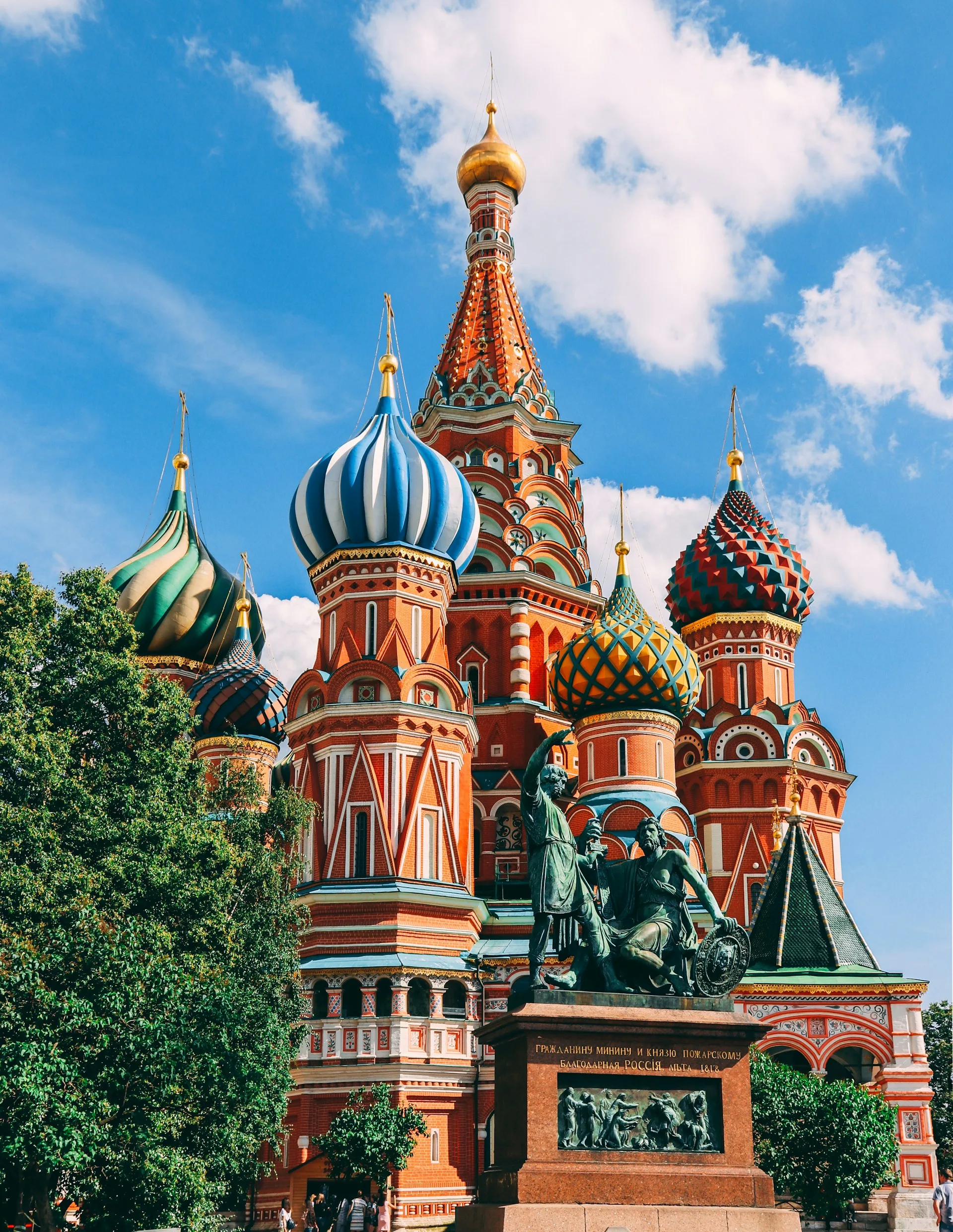
- Architecture -- from the onion domes of St. Basil's Cathedral to the Soviet constructivist masterpieces to the elegant Baroque palaces of St. Petersburg.
- Festivals and traditions -- Maslenitsa (pancake week), New Year celebrations (de Rusia biggest holiday), Victory Day, and regional cultural festivals.
As a student, you will have access to all of this at deeply discounted student prices. Theatre tickets, museum entries, and concert admissions often cost RUB 100-500 for students -- a fraction of the standard price.
A Large and Growing International Student Community
With over 350,000 estudiantes internacionales, Russia is among the top 10 study destinations globally. The largest groups come from:
- Central Asia -- Kazakhstan, Uzbekistan, Turkmenistan, Tajikistan, Kyrgyzstan
- China and Southeast Asia -- China, Vietnam, India, Malaysia
- Middle East and Africa -- Egypt, Iraq, Morocco, Nigeria, Cameroon
- Latin America -- Colombia, Ecuador, Brazil
- CIS countries -- Belarus, Ukraine, Moldova
This diversity creates a genuinely international campus environment, especialmente at major universities in Moscow, St. Petersburg, and Kazan. Most universities have:
- Estudiante internacional offices with dedicated support staff
- Buddy programs pairing new arrivals with current students
- Cultural associations representing dozens of nationalities
- idioma ruso support through preparatory faculties and language centres
Geography and Scale
Russia is the largest country on Earth, spanning 11 time zones and two continents. As a student, this means:
- Diverse experiences -- study in European Russia (Moscow, St. Petersburg), the Volga region (Kazan, Nizhny Novgorod), the Urals (Yekaterinburg), or Siberia (Novosibirsk, Tomsk)
- Natural wonders -- Lake Baikal (the world's deepest lake), the Caucasus Mountains, the Golden Ring of historic cities, Kamchatka's volcanoes
- Affordable domestic travel -- train travel across Russia is inexpensive and the rail network is extensive. Student discounts apply on many routes.
- Climate variety -- from the mild Black Sea coast to the dramatic Siberian winters, puedes choose a climate that suits you
Is Russia Right for You?
Russia is an excellent choice if:
- You want a quality degree without massive debt -- tuition and costes de vida combined are lower than almost any other major study destination
- You are interested in STEM, medicine, or engineering -- these are de Rusia strongest fields, backed by decades of global excellence
- You want to learn Russian -- one of the world's most strategically valuable languages, essential for careers in diplomacy, energy, security, and international business
- You appreciate cultural depth -- de Rusia artistic, literary, and musical heritage is genuinely world-class
- You are open to a different kind of experience -- studying en Rusia means stepping outside the comfortable Western bubble, which builds adaptability and a broader worldview
Russia might not be the best fit if:
- You want everything in English -- while programas impartidos en ingles are growing, daily life en Rusia operates en Rusian, and most programs are still Russian-medium
- You need a warm climate year-round -- Russian winters are cold, dark, and long, especialmente outside the southern regions
- You want minimal bureaucracy -- de Rusia visa and registration processes require patience and careful documentation
- You prioritize international employer name recognition above all else -- while universidades rusas are well-known in STEM and medicine, they may be less recognized by some employers in non-technical fields comparado con Western universities
Proximos Pasos
Ready to start planning? Here is your path forward:
- Plan your studies -- build a timeline, understand requirements, and choose your intake
- Explore programs and universities -- find the right university from de Rusia top institutions
- Understand costs and funding -- build a realistic budget and learn about the Government Scholarship
- Prepare your application -- learn the process, deadlines, and required documents
Preguntas frecuentes
Is studying en Rusia affordable?
Is a Russian degree recognized internationally?
Puedo study en Rusia in English?
Is Russia safe for estudiantes internacionales?
Necesito to speak Russian before arriving?
Que es el/la Russian Government Scholarship?
Como funciona Russia compare to other study destinations?
What fields is Russia strongest in?
Guías relacionadas
Planifica tus Estudios en Rusia
Start planning 9-12 months ahead with this step-by-step timeline covering intakes, credential recognition, idioma ruso prep, and the preparatory faculty year.
🎓Programas y Universidades en Rusia
From Moscow State and MIPT to ITMO and HSE, find the right universidad rusa and program for your goals with this comprehensive guide a Rusia's top institutions.
📝Admision y Solicitud for Russia
Master the universidad rusa proceso de solicitud -- from the Study en Rusia portal and Government Scholarship to direct admission, document legalization, and examen de ingresos.
💰Costes y Financiacion
Un desglose realista de tasas de matricula, costes de vida por ciudad, becas y ganancias por trabajo a tiempo parcial para estudiantes internacionales en Irlanda.
🛂Visado y Llegada en Rusia
Estudiantes internacionales need a Russian visado de estudiante with an invitation letter from their university. Here's the complete process -- documents, HIV test, registration, and seguro medico.
🏡Living en Rusia as a Student
Everything necesitas know about student housing, city life, metro systems, healthcare, cultura rusa, weather, food, and safety tips for estudiantes internacionales en Rusia.
💼Trabajo y Carrera en Rusia
From limited trabajo a tiempo parcial options during studies to post-graduation career paths in energy, tech, aerospace, and mining -- your guide to working during and after studying en Rusia.