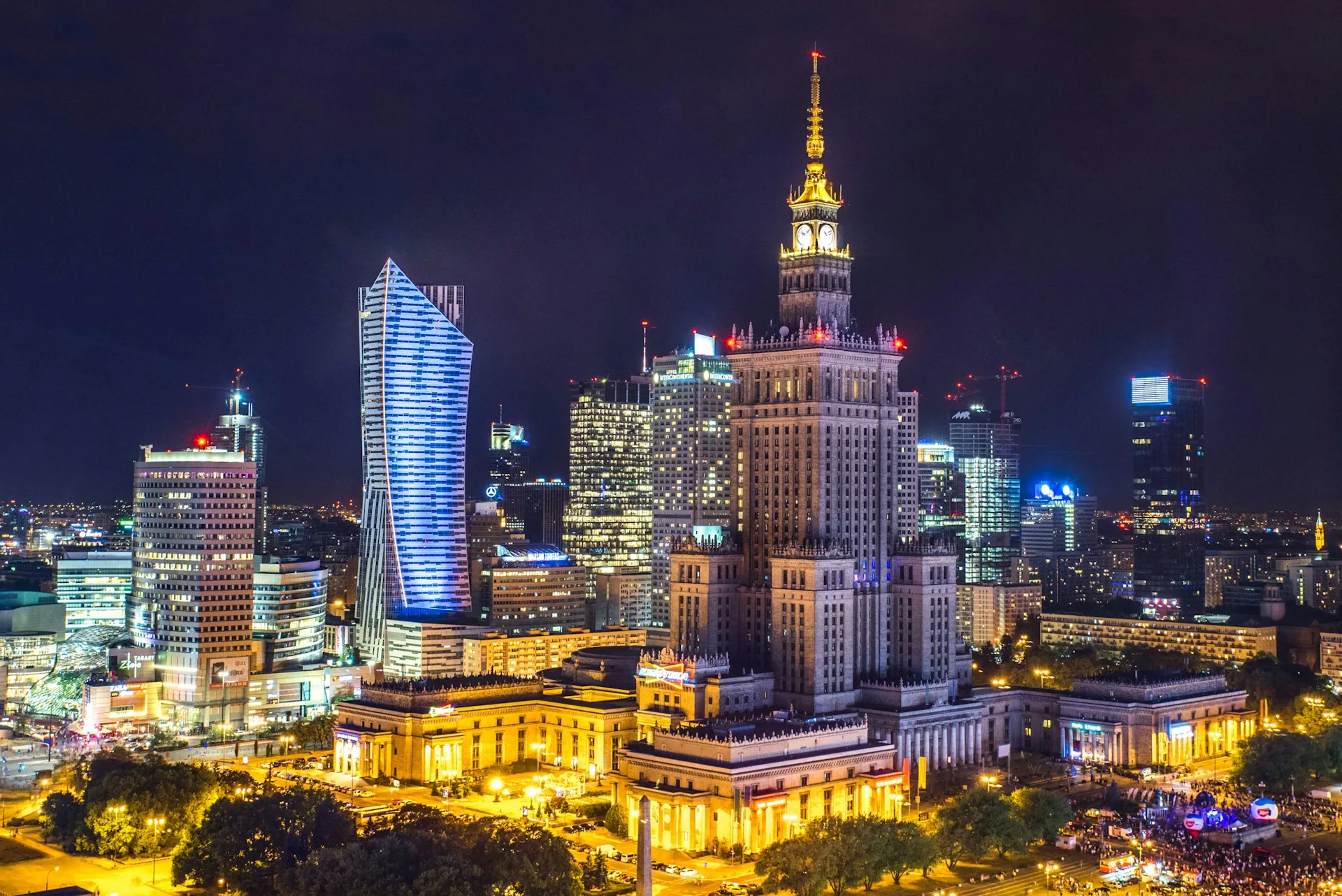
폴란드 유학을 선택하는 이유
Poland combines genuinely affordable tuition, 800+ 영어 수업 프로그램, centuries-old universities, and a booming tech economy — here's why over 85,000 유학생 choose it every year.
Why 폴란드 유학
Poland has emerged as one of Europe's most compelling study destinations, and it is not hard to see why. With 학비 that are a fraction of what you would pay in the UK or US, over 800 English-taught degree programs, universities with centuries of academic tradition, and a fast-growing economy that is creating real career opportunities — Poland offers a package that few countries in Europe can match. More than 85,000 유학생 from over 170 countries have already discovered this. Here is why you should consider joining them.
Genuinely Affordable Tuition
The single biggest draw for many 유학생 is the cost. Poland offers high-quality European education at prices that make it accessible to students from around the world.
Typical annual 학비 at 폴란드 public universities
| 분야 of study | Annual tuition (EUR) |
|---|---|
| Humanities and social sciences | EUR 2,000-3,000 |
| Business and economics | EUR 2,000-4,000 |
| Engineering and IT | EUR 2,500-4,000 |
| Sciences (physics, chemistry, biology) | EUR 2,000-3,500 |
| Medicine and dentistry | EUR 10,000-14,000 |
| Architecture and design | EUR 3,000-5,000 |
EU/EEA students have an additional advantage: if you pass entrance exams in Polish, you can study at public universities tuition-free, just like 폴란드 학생. Many EU students choose 영어 수업 프로그램 instead, which carry 학비, but the option exists for those who learn Polish.
How Poland compares
| 비용 comparison | Poland | UK (international) | Germany (public) | Netherlands |
|---|---|---|---|---|
| Annual tuition | EUR 2,000-4,000 | GBP 15,000-35,000 | EUR 0-300 (mostly German-taught) | EUR 8,000-15,000 |
| Monthly 생활비 | EUR 500-800 | GBP 1,000-1,500 | EUR 900-1,200 | EUR 900-1,200 |
| 3-year Bachelor's total cost | EUR 24,000-43,000 | GBP 66,000-150,000 | EUR 32,000-43,000 | EUR 56,000-80,000 |
팁: Some 폴란드 대학교 offer tuition discounts of 10-20% for early application, full upfront payment, or academic excellence. Always ask about available reductions when you apply.
The total cost of a full degree 폴란드에서 — including tuition and living expenses — is often less than a single year at a UK or US university. This makes Poland especially attractive for students from countries where education funding is limited.
Over 800 English-Taught Programs
A common concern is whether you can 폴란드에서 공부 without speaking Polish. The answer is a clear yes — Poland now offers over 800 degree programs taught entirely in English, and the number grows every year.
영어 수업 프로그램 by field
- Medicine and dentistry — Poland is one of Europe's most popular destinations for English-taught medical degrees, with programs at the Medical Universities of Warsaw, Krakow, Poznan, Lodz, Gdansk, and others
- Business and management — MBA programs, international business, finance, and marketing at schools like Kozminski University (triple-accredited), Warsaw School of Economics (SGH), and Poznan University of Economics
- Engineering and technology — computer science, civil engineering, mechanical engineering, and IT at Warsaw University of Technology, AGH University of Krakow, and Wroclaw University of Science and Technology
- Humanities and social sciences — international relations, European studies, psychology, and sociology at major universities
- Sciences — physics, chemistry, biotechnology, and environmental science
You can search the full database of 영어 수업 프로그램 on the 폴란드 유학 (studyinpoland.pl) website and through NAWA's programme catalogue.
팁: Even if your program is in English, learning basic 폴란드 (A1-A2 level) will make your daily life much easier and richer. Most universities offer free 폴란드 courses for 유학생 through their language centres.
Historic Universities with Modern Standards
Poland's academic tradition stretches back over 650 years. Jagiellonian University in Krakow, founded in 1364, is one of the oldest universities in the world — older than most universities in Germany, the UK (except Oxford and Cambridge), and all universities in the Americas. Nicolaus Copernicus studied there.
But 폴란드 higher education is not just about history. The system has modernised significantly since Poland joined the EU in 2004, with billions in EU funding invested in facilities, research infrastructure, and international programs.
Top-ranked 폴란드 대학교
| University | City | Founded | Notable strengths |
|---|---|---|---|
| University of Warsaw | Warsaw | 1816 | Largest university 폴란드에서; strong in sciences, law, economics |
| Jagiellonian University | Krakow | 1364 | Oldest 폴란드에서; medicine, humanities, sciences |
| Warsaw University of Technology | Warsaw | 1826 | Poland's leading technical university; engineering, IT, architecture |
| AGH University of Krakow | Krakow | 1919 | Mining, metallurgy, IT, engineering, energy |
| University of Wroclaw | Wroclaw | 1702 | Sciences, law, humanities; vibrant international community |
| Gdansk University of Technology | Gdansk | 1904 | Engineering, naval architecture, nanotechnology |
| Adam Mickiewicz University | Poznan | 1919 | Humanities, biology, physics, modern languages |
| Kozminski University | Warsaw | 1993 | Triple-accredited business school (AACSB, EQUIS, AMBA) |
폴란드 대학교 have been climbing international rankings steadily. The University of Warsaw and Jagiellonian University both feature in the QS World University Rankings top 300, and several 폴란드 institutions rank among the best in Central and Eastern Europe.
A Growing Economy and Tech Hub
Poland's economy is one of the EU's great success stories. It is the 6th-largest economy in the EU, the only EU country that avoided recession during the 2008 financial crisis, and has maintained consistent GDP growth for over 30 years.
Key economic sectors
- Information technology — Poland has the largest IT talent pool in Central Europe, with major development centres for Google, Microsoft, Amazon, Samsung, Intel, and Oracle. Homegrown companies like CD Projekt (The Witcher, Cyberpunk 2077), Allegro (e-commerce), and InPost (logistics tech) are global players.
- Business Process Outsourcing (BPO) and Shared Services — Warsaw, Krakow, Wroclaw, and Katowice host hundreds of BPO and shared services centres for companies like JPMorgan, Goldman Sachs, HSBC, Credit Suisse, and Shell. These centres employ over 350,000 people and actively recruit multilingual 대학원s.
- Manufacturing and automotive — major production facilities for Volkswagen, Toyota, Mercedes, and hundreds of automotive suppliers
- Gaming and creative industries — Poland is one of Europe's largest gaming markets, with studios like CD Projekt Red, Techland, and 11 bit studios
- Finance and banking — a well-developed banking sector with growing fintech companies
This economic dynamism translates directly into career opportunities for 대학원s. Poland's unemployment rate is among the lowest in the EU, and skilled 대학원s — especially in IT, engineering, finance, and business services — are in high demand.
EU Membership and Its Benefits
Poland joined the EU in 2004, and this membership delivers concrete advantages for students:
- Degree recognition — 폴란드 학위s are recognised across all EU/EEA countries through the Bologna Process and ECTS system
- Erasmus+ participation — 폴란드 대학교 are active in Erasmus+ exchanges, allowing you to spend a 학기 at partner universities across Europe
- Freedom of movement for EU students — no visa needed; study, live, and work freely
- EU funding for research — 폴란드 대학교 receive significant Horizon Europe and structural fund grants, supporting modern labs, equipment, and research opportunities
- Schengen area access — travel visa-free across 27 European countries during your studies
For non-EU students, a 폴란드 학생 비자 gives you access to the Schengen zone for short trips, making it easy to travel across Europe during 학기 breaks.
Rich Culture and Student Life
Poland offers a cultural experience that is deeply rewarding and refreshingly different from Western Europe:
- History everywhere — from Krakow's stunning medieval Old Town (UNESCO World Heritage) to Warsaw's painstakingly rebuilt historic centre, Gdansk's colourful merchant houses, and Wroclaw's charming islands and bridges
- Food culture — 폴란드 요리 is hearty, delicious, and incredibly affordable. Pierogis, zurek soup, bigos (hunter's stew), and zapiekanka (폴란드 baguette pizza) are student staples. A full meal at a milk bar (bar mleczny) costs EUR 2-4
- Nightlife and festivals — 폴란드 student cities have legendary nightlife. Krakow alone has hundreds of bars in its medieval cellars. Music festivals (Open'er, OFF Festival), film festivals, and cultural events run year-round
- Nature access — the Tatra Mountains are a two-hour drive from Krakow, the Masurian Lakes offer sailing and kayaking, and the Baltic coast has beautiful beaches
- Central location — Poland borders Germany, Czech Republic, Slovakia, Ukraine, Belarus, Lithuania, and Russia (Kaliningrad), with budget flights to all of Europe from as little as EUR 15-30
팁: Get a student ID card (legitymacja studencka) immediately — it gives you 50% off 대중교통 and discounts at museums, cinemas, theatres, and many restaurants 폴란드 전역에서.
A Welcoming International Community
Poland's 유학생 population has grown rapidly — from around 12,000 in 2005 to over 85,000 today. The top sending countries include Ukraine, Belarus, India, Turkey, Spain, Germany, and countries across Asia, Africa, and the Americas. This diversity means:
- Dedicated 유학생 offices at every major university, with English-speaking staff
- Buddy programs pairing 유학생 with 폴란드 mentors
- Orientation weeks with city tours, administrative support, and social events
- ESN (Erasmus Student Network) sections at most universities organising trips, parties, and cultural exchanges
- International student associations and country-specific groups
폴란드 사람들 are generally hospitable and curious about international visitors. While older generations may speak limited English, younger Poles (especially in university cities) are typically conversant in English and happy to help.
Is Poland Right for You?
Poland is an excellent choice if:
- You want affordable, quality education in the EU — tuition and 생활비 are among the lowest in Europe, with strong academic standards
- You want to study in English — 800+ programs mean you have plenty of choices without learning Polish
- You are interested in medicine — Poland is one of the best-value destinations for English-taught medical degrees recognised across the EU
- You want career opportunities in a growing economy — IT, BPO, finance, and engineering sectors are booming
- You enjoy history, culture, and affordable living — Poland offers all three in abundance
- You want a European base — central location with easy access to all of Europe
Poland might not be the best fit if:
- You want tuition-free education — Germany offers that (though mostly in German and with higher 생활비)
- You are looking for a warm, Mediterranean climate — 폴란드 winters are cold (down to minus 15-20 degrees Celsius)
- You want a primarily English-speaking environment outside the classroom — daily life operates in Polish, and basic language skills are very helpful
- You prioritise global brand-name university recognition — while improving, 폴란드 대학교 are not yet as widely known as Oxford, MIT, or Sorbonne
다음 단계
Ready to start planning? Here is your path forward:
- Plan your studies — build a timeline, understand the academic calendar, and navigate the 폴란드 시스템
- Explore programs and universities — find the right program from over 400 institutions
- Understand costs and funding — build a realistic budget and find 장학금s
- Prepare your application — learn the process, deadlines, and required documents
자주 묻는 질문
Is 폴란드 유학 really affordable?
Can I 폴란드에서 공부 in English?
Are 폴란드 학위s recognised internationally?
How does Poland compare to Germany or the Czech Republic for 유학생?
Is Poland safe for 유학생?
What is the quality of life like for students 폴란드에서?
Do I need to learn 폴란드 to 폴란드에서 공부?
What career opportunities exist after 폴란드 유학?
관련 가이드
폴란드 학업 계획
A complete planning guide covering the 폴란드 academic calendar, October and February intakes, credential recognition through NAWA, 폴란드어 courses, and choosing between public and private universities.
🎓폴란드 프로그램 및 대학교
A comprehensive guide to 폴란드 higher education institutions — top universities, technical universities, medical schools, private institutions, and the 800+ 영어 수업 프로그램 available.
📝폴란드 입학 및 지원
Navigate the 폴란드 admissions process — the IRK online system, direct applications, required documents, sworn translations, and application timelines for 유학생.
💰폴란드 비용 및 재정 지원
A realistic breakdown of 학비, 생활비, 장학금s, and 아르바이트 earnings 폴란드에서 — one of the most affordable study destinations in the EU.
🛂폴란드 비자 및 입국
Complete guide to the 폴란드 학생 비자 (national visa type D) — requirements, 지원 절차, 체류 허가s, and your first-week checklist after landing 폴란드에서.
🏡폴란드에서의 생활
Everything you need to know about daily life as an 유학생 폴란드에서 — housing, healthcare, transport, food, culture, and safety in one of Europe's most affordable countries.
💼폴란드 취업 및 경력
Your complete guide to working while 폴란드 유학 — student work rights, finding jobs, 졸업 후 career pathways, and Poland's booming tech and BPO sectors.